

By: Wenzhou ZhiyuanTechnical Team
Date: September 22, 2026
Reading Time: ~8 minutes
When specifying stainless steel for chemical processing, offshore piping, or pharmaceutical clean systems, the choice between 304L and 316L often determines whether your system survives its first year of service or fails from chloride-induced pitting. The price difference is typically 15–25%, but the cost of selecting the wrong grade—premature corrosion, leaks, and unplanned downtime—far exceeds the initial material premium.
As a professional supplier of stainless steel pipe fittings and flanges, Wenzhou Zhiyuan helps engineers and procurement teams navigate this decision daily. This guide breaks down 316L’s properties, its critical advantage over 304L, and the flange selection rules that matter for long-term reliability.
1. What Makes 316L Different: Molybdenum
316L is the low-carbon version of 316 stainless steel, with carbon content capped at 0.030% (same as 304L). But its defining alloying element is molybdenum (Mo), added at 2.0–3.0%.
That 2–3% Mo content raises the Pitting Resistance Equivalent Number (PREN) from roughly 19 (304L) to approximately 26 (316L). PREN is a practical formula (Cr + 3.3×Mo + 16×N) used to estimate resistance to localized corrosion—pitting and crevice attack. The jump from 19 to 26 is the difference between “adequate for clean water” and “capable of handling chlorides”.
2. Why 304L Fails in Chlorides—and 316L Doesn’t
Seawater, brackish cooling water, and many chemical process streams contain chloride ions (Cl⁻). Chlorides attack the passive chromium-oxide film that protects stainless steel, causing pitting corrosion. Once pitting initiates, it can penetrate wall thickness rapidly and lead to leaks.
Industry data shows a clear threshold: 304L is appropriate for chloride concentrations below roughly 200 ppm, while 316L is required above that level. For seawater (chloride content ~19,000 ppm) or offshore environments, 316L is the minimum acceptable grade—though in severely corrosive conditions, even 316L may not suffice, and duplex stainless steels such as 2205 or 2507 may be required.
The “L” designation (low carbon) matters for the same reason it does with 304L: it prevents chromium carbide precipitation at grain boundaries during welding (sensitization). Both 304L and 316L are the default choices for welded piping systems precisely because they maintain corrosion resistance in the weld heat-affected zone without post-weld heat treatment.
3. Mechanical Properties and Temperature Ratings
The low-carbon chemistry of 316L slightly reduces minimum mechanical strength compared to standard 316:
Property 316L (Low Carbon)
Tensile strength (min) 485 MPa (70 ksi)
Yield strength (min) 170 MPa (25 ksi)
Elongation 40% (typical)
These values are identical to 304L. In most piping designs, wall thickness is governed by pressure requirements rather than minimum allowable stress, so the modest reduction is rarely a limiting factor.
For high-temperature service, 316L is generally limited to about 800°F (427°C) in ASME B31.3 applications. Above this range, standard 316 or 316H may be required for adequate creep strength.
4. Flange Selection for 316L Systems
4.1 Material Specification
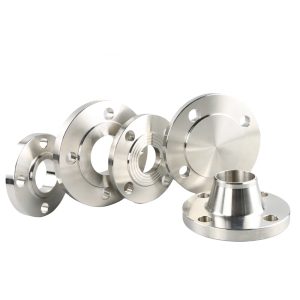
For forged 316L flanges, the governing ASTM specification is ASTM A182 F316L. This covers forged or rolled alloy and stainless steel pipe flanges, forged fittings, and valves and parts intended for high-temperature service. Look for this marking on the flange itself or in the material certificate.
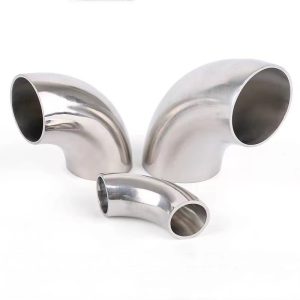
For 316L butt weld fittings, the matching specification is ASTM A403 WP316L.
4.2 Flange Face Types and Gasket Selection
Raised Face (RF) is the most common facing for 316L flanges in chemical and process piping. The raised ¼” platform concentrates gasket seating stress and is suitable for Class 150 through 2500 flanges.
Flat Face (FF) is used primarily for low-pressure Class 150 applications or when mating with cast iron or plastic flanged equipment, where bolting load could crack the mating flange.
Ring Type Joint (RTJ) is specified for high-pressure and high-temperature services. In hydrocarbon service, RTJ is commonly required for Class 600 and above (gas) or Class 900 and above (liquid). RTJ gaskets are typically soft iron or low-carbon steel rings, though 304 and 316 stainless steel rings are also used.
The gasket material must be compatible with 316L flanges. For RF flanges in general service, spiral-wound gaskets (graphite or PTFE filler with stainless steel winding) are standard for high-pressure/temperature or corrosive services.
4.3 Bolting: Do Not Use 316L Bolts
A critical error in 316L flange assemblies: using 316L bolts. Like 304L, 316L has relatively low yield strength (170 MPa). Under the high preload required for a pressure-tight joint, 316L bolts can yield or relax, leading to leakage.
For 316L flanged joints, the correct bolting specification is typically ASTM A320 Grade B8M (for low-temperature service) or A193 B8M (for elevated temperature), with matching A194 Grade 8M nuts. These are high-strength austenitic stainless steel bolts designed specifically for flanged joints.
4.4 Pressure-Temperature Ratings
316L flanges conform to ASME B16.5 pressure-temperature ratings, which cover Class 150, 300, 400, 600, 900, 1500, and 2500 for NPS 1/2 through 24 (Class 2500 limited to NPS 1/2–12). The rating tables show allowable pressure decreasing with increasing temperature. At 100°F, a Class 150 316L flange is rated for 275 psig (1.9 MPa); at 800°F, the same flange is rated for only 150 psig (1.0 MPa).
5. Selection Checklist: 304L vs. 316L
Service Condition Recommended Grade
Clean water, steam, dilute acids, food processing 304L adequate
Chloride concentration > 200 ppm 316L required
Seawater, brackish water, offshore 316L minimum (consider duplex)
Chemical process with chlorinated solvents 316L required
Pharmaceutical WFI (Water for Injection) 316L preferred
High-temperature (>800°F) 316/316H, not 316L
For most new piping projects in chemical and petrochemical plants, 316L is the default choice for process piping. 304L is used where chloride exposure is negligible and cost savings justify the reduced corrosion margin.
Conclusion
316L’s molybdenum content provides the chloride resistance that 304L lacks, making it the practical standard for chemical processing, offshore, and pharmaceutical piping systems. The low-carbon “L” chemistry ensures weldability without sensitization risk. When specifying 316L flanges, remember three rules: use ASTM A182 F316L material, select the correct face type for your pressure class, and never use 316L bolts—specify A320 B8M or A193 B8M instead.
At Wenzhou Zhiyuan, we supply ASTM-compliant 316L pipe fittings and flanges, including ASME B16.5 flanges in all pressure classes and butt weld fittings to ASTM A403. Contact our engineering team for material selection support on your specific service conditions.
Wenzhou Zhiyuan is a professional supplier of industrial pipe fittings and flanges, serving chemical, petrochemical, offshore, and pharmaceutical clients worldwide. We offer 304L, 316L, and duplex stainless steel in multiple configurations, with full material traceability and third-party inspection support.